AI-Powered IT Support: From Email to Pre-Filled Ticket in Seconds
An IT managed services company receives a support email at 8:47 AM. By 8:47 and twelve seconds, a fully categorised ticket exists in their system - with priority set, the right team assigned, a problem diagnosis written, and three similar past tickets linked with their resolutions. No human has touched it yet.
Stages 1-3: Before any AI runs
Stage 1 extracts the email: sender, subject, body, attachments, and thread context. If this is a reply in an existing thread, the pipeline links it to the original ticket and stops.
Stage 2 identifies the sender. Domain lookup to company, contact record, contract details, SLA tier.
Stage 3 is the entitlement gate. If the sender has no active contract, the pipeline stops. No AI processing, no API credits spent. The expensive stages only run for paying customers.
Stage 4: Problem analysis
The AI reads the email body plus attachments - screenshots, log files, error exports. It classifies severity, identifies the affected system, and extracts specific error codes. The output is a structured problem description that preserves detail for downstream stages.
Stage 5: Historical search
The problem description gets embedded into a vector embedding. The database’s vector index searches 10,000+ past tickets by problem similarity. A ticket about 'Outlook keeps freezing' matches 'email client unresponsive after update' because the vectors capture the underlying problem, not surface language. Returns three to four matches with full resolution details.
Stage 6: Diagnosis
The LLM receives the current problem analysis and similar past resolutions. It generates a diagnosis and recommended fix with a confidence score. When three past tickets all resolved with the same fix, confidence is high. When the problem is novel, the system says so explicitly.
Stage 7: Ticket creation
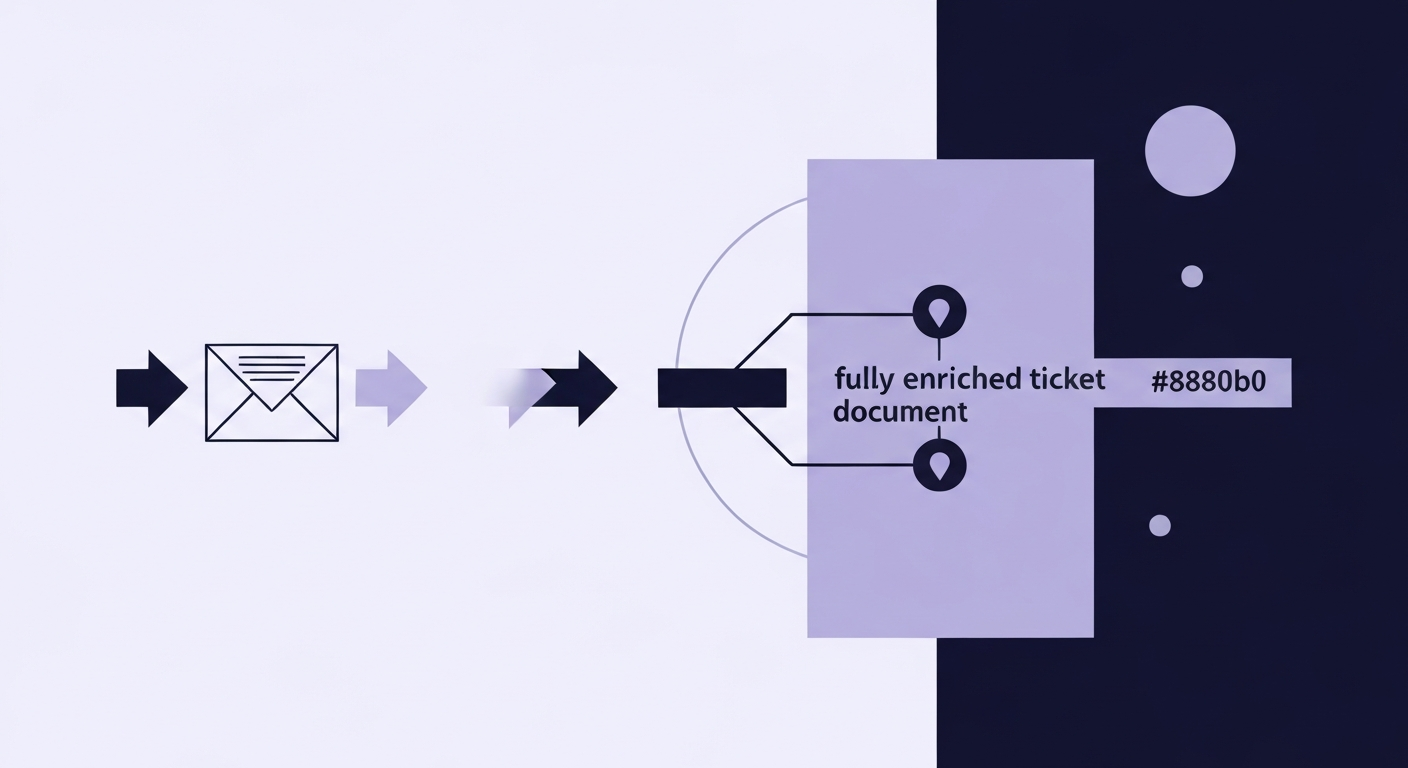
The final ticket arrives pre-filled: category, priority, assigned team, problem summary, AI diagnosis, similar tickets linked, resolution recommendation. The agent opens a ticket with more context than 15 minutes of manual investigation would produce.
The dual-vector design
Two separate embeddings per ticket: one captures symptoms at creation, the other captures the resolution at close. New tickets search against symptom embeddings. Diagnosis reads resolution embeddings of matches. Keeping them separate prevents signal dilution.
All data runs inside the database on-premise. The human always reviews before any action is taken. The pipeline handles investigation. The human handles judgment.
Want to discuss your specific situation?
Every automation problem is different. A short conversation is usually enough to see what is possible.
Get in touch →